Search
Search
21 September 2026

MYCOTRACE® 2026 Q2
As Fusarium pressure persists and ZEN and T-2 become more prominent, multi-mycotoxin contamination is becoming a more complex area to manage.
THREE KEY MESSAGES FROM Q2
PERSISTENT BASELINE
Across the four-year outlook, FUM remains the most consistent component of the risk profile.
SHIFT THIS QUARTER
The increasing prominence of ZEN and T-2 shows that a single-toxin interpretation is no longer sufficient.
MANAGEMENT FOCUS
More complex toxin combinations directly affect sampling and follow-up plans.
2026 Q2 does not signal a new field risk. It shows that the established Fusarium baseline has become more layered as different toxins occur together. The key question is no longer only which toxin is most prevalent, but which toxins co-occur and how the combination changes the operation’s risk profile.
How to read the charts
The charts summarise the analytical picture. Rather than repeating the same figures, the text explains the direction of change, the structure of the risk and its implications for the operation.
QUARTER-ON-QUARTER CHANGE
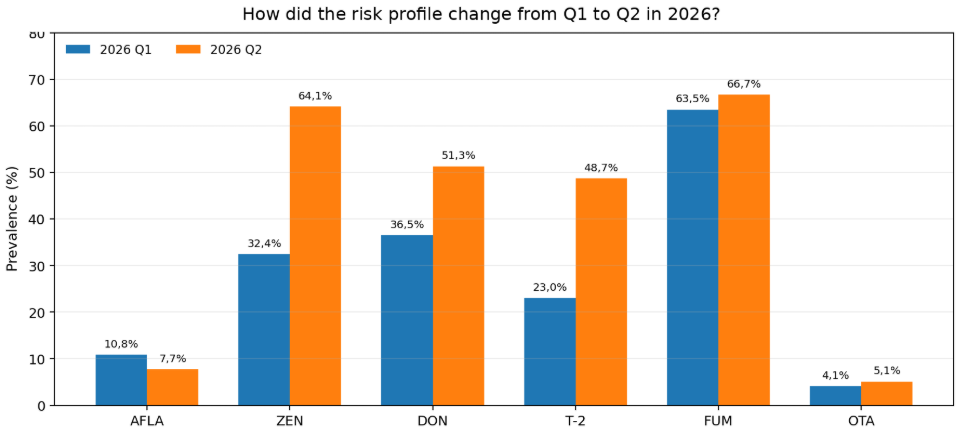
In Q1, the profile centred on FUM. By Q2, the gap between FUM and other Fusarium toxins had narrowed. The greater prominence of ZEN and T-2 indicates a shift from one dominant toxin to a broader combination profile.
Persistent DON makes cereal and cereal by-product monitoring essential across procurement, formulation and storage. Lower AFLA and OTA prevalence does not remove operational risk; source, concentration, feed matrix and exposure duration remain decisive.
Key interpretation for this quarter
FUM is the constant point in the risk profile, while ZEN, DON and T-2 determine its depth. The management approach should therefore be based on the full combination, not solely on the dominant toxin.
SAME-QUARTER COMPARISON
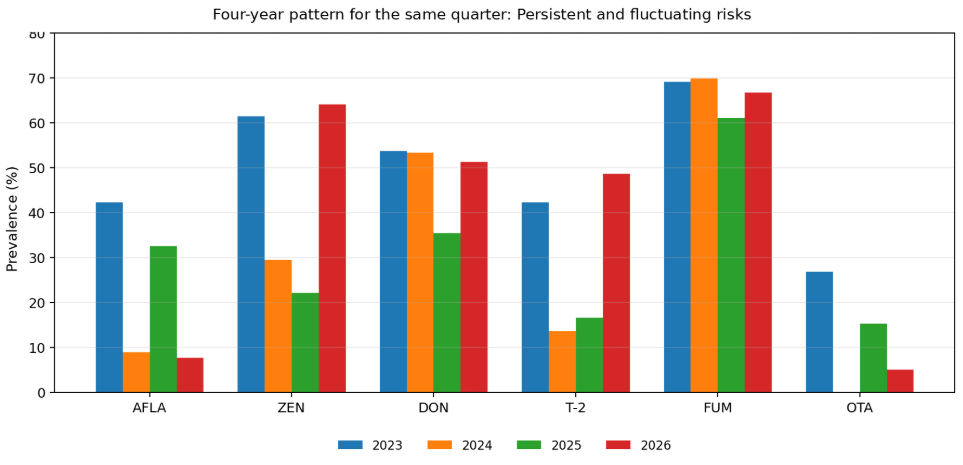
Comparing the same quarter across four years partially controls for seasonal effects and makes the structural features of the risk profile more visible. FUM stands out as the most consistent risk over time. Monitoring maize and maize-derived inputs is therefore not a temporary measure, but an ongoing management priority.
PERSISTENT RISK
FUM remaining within a similar range over the years indicates a structural and recurring risk baseline.
FLUCTUATING RISK
Sharp year-to-year changes in ZEN and T-2 increase the importance of source- and period-specific monitoring.
SOURCE-SPECIFIC RISK
Variability in AFLA and OTA requires assessment by batch, supplier and storage condition rather than broad national interpretation.
Although DON rises and falls between years, it remains a recurring component of the profile. By contrast, the prominence of ZEN and T-2 in 2026 Q2 distinguishes the current period from previous years. Fixed programmes based solely on the most prevalent toxin in the previous year may therefore fail to reflect the risk architecture of the new period.
Decision statement
Long-term data show which risks are persistent. Current-quarter data reveal which combination is now emerging against that established baseline.
MULTI-MYCOTOXIN CONTAMINATION
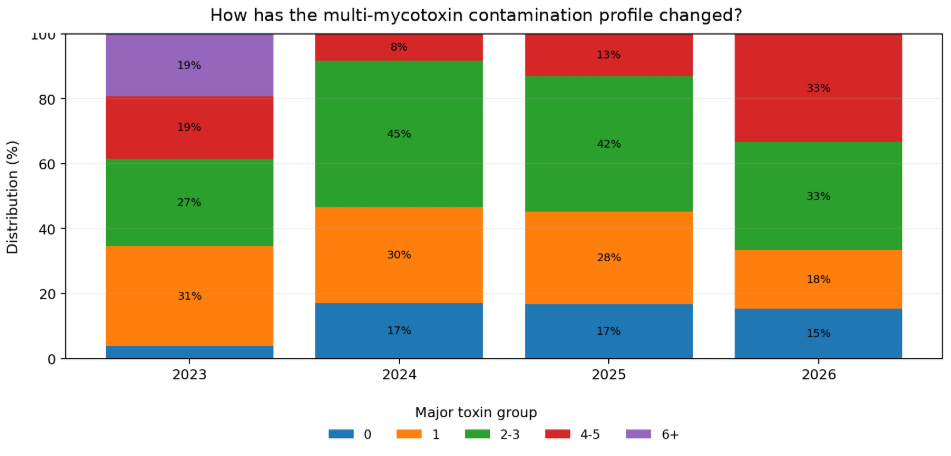
The defining feature of 2026 Q2 is not merely the presence of multiple toxins, but the greater visibility of more complex combinations within the data set. Single-toxin profiles have become less prominent, while profiles containing four or five major toxins have become more evident.
This finding does not prove that synergistic effects or performance losses occur in every sample. However, a greater number of toxins makes biological effects more difficult to interpret and increases the relevance of low-level but persistent exposure. Toxin count should therefore be assessed together with concentration, feed intake, exposure duration, animal age and production stage.
Important
The absence of 6+ toxins does not indicate low risk. A profile containing four or five toxins may represent a strong management signal, depending on the species and exposure conditions.
TECHNICAL INTERPRETATION BY SPECIES
The following comments do not represent the analytical results themselves. They provide a technical framework for the biological and operational areas that should be monitored for each species in relation to the Q2 profile.
POULTRY
The DON, T-2 and FUM-dominant profile should be monitored in relation to feed intake, intestinal integrity, nutrient utilisation and flock resilience. In broilers, growth and feed conversion are key; in layers and breeders, continuity over long production cycles is particularly important.
RUMINANTS
Biotransformation by the rumen microbiota does not provide absolute protection. When ZEN is prominent, fertility records should be reviewed; when DON, T-2 and FUM are present, feed intake, rumen stability, hepatic burden and metabolic load should be assessed together.
SWINE
Given their sensitivity to DON and ZEN, the Q2 profile requires priority monitoring of feed intake and growth, as well as fertility in breeding herds. Risk profiles should be assessed separately for young animals and breeding groups.
AQUACULTURE
In feeds with greater inclusion of plant-based raw materials, Fusarium toxins become relevant to appetite, growth, feed conversion, intestinal health and liver health. Species, life stage and diet formulation may alter the biological significance of the same analytical result.
ACTIONABLE MANAGEMENT
DECISION SUPPORT MODEL
Samples and Data
Accredited Analysis
Risk Profile
Technical Interpretation
Operation-Specific Assessment
Management Strategy
Follow-up
MYCOTRACE® does not present the Türkiye and regional outlook solely as a risk map. It links F.A.S.T. Lab. analytical data with the operation’s raw-material profile, feed matrix, animal species, production stage and historical results to develop an actionable technical risk profile.
The key message from 2026 Q2 is clear: The centre of risk has not shifted, but the profile has deepened. Effective mycotoxin management requires a dynamic system that monitors toxin combinations, animal species and changes over time together, rather than relying on fixed decisions based on a single result.
Assess Your Operation-Specific Risk Profile.
Contact the MYCOTRACE® expert team for support with sampling plans, technical interpretation and follow-up strategies.
DVM Susen Gizem Ertaş
Technical Marketing Manager – Turkey & MENA
Let's get in touch to help you find the right product.